

Most of what a connected infrastructure does in an airport is quietly practical: wayfinding, flight information, baggage status. Occasionally, the same infrastructure is asked to do something else entirely: define the terminal itself, becoming the thing passengers photograph and remember long after they have forgotten which gate they boarded from.
The same platform, turned up to eleven
Large-format experiential installations, architectural LED facades, 360-degree media columns, immersive destination environments, run on the same connected infrastructure as every practical screen in the terminal, powered by StudioDX, the visual layer of that infrastructure. Canvases up to 16K by 16K, in any shape, with frame-accurate synchronisation across every panel, all scheduled, managed and played out from the same platform that runs a wayfinding kiosk twenty metres away.
That shared foundation is what makes ambitious visual design achievable without a bespoke, one-off technical build for every installation. The scheduling, playout and content management problem has already been solved once, at the platform level, which means a new large-format canvas is a design and content exercise rather than a new engineering project.
It also means content for a large-format installation can draw on the same widget library used everywhere else in the terminal, live flight data, destination content, wayfinding cues, rather than existing as a completely separate creative production with no connection to the rest of the passenger experience.
A landmark, not just a large screen
At Hartsfield-Jackson Atlanta International, ATLAS, a custom LED sphere, and a series of 360-degree LED media columns across the concourses turn transit space into a signature moment, the kind of installation that becomes a landmark in its own right rather than simply a bigger version of a departures board. Passengers, and the media coverage that follows a genuinely striking installation, treat it as a destination rather than infrastructure.
That reputational value compounds for the airport as a whole. A terminal known for a signature visual moment sets an expectation of quality that extends to how passengers perceive every other part of the experience, including the parts, like wayfinding and flight information, that never make it into a photograph.
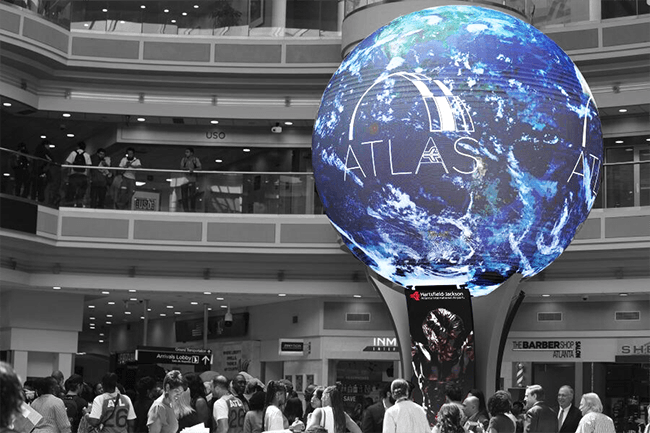
Photo courtesy of Capital Signs
Why the infrastructure underneath still matters
A large-format installation is the highest-visibility test of an infrastructure's reliability: any failure is immediately, publicly obvious, in a way a single malfunctioning wayfinding kiosk is not. Building experiential installations on the same signage-grade platform that runs the rest of the terminal, rather than a bespoke one-off build, is what keeps a landmark installation running as reliably as the departures board beside it.
It is worth asking any partner proposing a large-format installation the same question that applies to every other screen in the terminal: what happens if a panel fails during a live event, and how quickly does the system recover? The answer separates a showstopper built on genuine infrastructure from an impressive one-off that is one hardware fault away from an embarrassing, highly visible outage.
Where this sits in an airport's wider plans
Large-format experiential work is often the last use case an airport adds, once wayfinding, flight information and signage are already running on connected infrastructure, because it benefits from a proven platform rather than requiring one. That sequencing tends to produce a better outcome than treating a landmark installation as a standalone project: the scheduling, playout and monitoring capability it depends on has already been tested on lower-stakes, everyday screens first.
Airports considering a signature installation as their opening move onto a connected infrastructure are usually better served starting with a more contained use case, and treating the large-format moment as the proof point that the underlying platform is ready for its highest-visibility test.
Conclusion
The showstopper moments are where a connected infrastructure proves it was never just about screens. It was always about running an environment, at any scale the environment demands, from the smallest directional sign to the largest architectural canvas.
Want to explore what a signature large-format experience could look like in your terminal? Get in touch to talk through what's possible.
what's next
Want to know more?
Book a consultation with our experts
By submitting this form you agree to our terms.