

Arrivals halls generate more staff questions per passenger than almost anywhere else in an airport.
Where's my bag? Which carousel? Where's the taxi rank?
Passengers who have just landed, often after a long flight, in an unfamiliar city, want answers immediately, and a carousel number on its own rarely gives them enough to actually act on.
Smart BIDS, short for baggage information display systems, brings the same connected infrastructure that already runs wayfinding and flight information into the one part of the journey that most airports still treat as an afterthought.
One glance, every question answered
A smart baggage information display composes bag status by flight, a live carousel map showing which belts are active, ground transport guidance covering taxis, rideshare, rail and car rental, and a local welcome with weather and city information, all from the same connected infrastructure that guided the passenger from their gate. None of these elements need a separate system: they are widgets composed onto one template, the same model used across every other screen in the terminal.
The live carousel map in particular addresses a specific, common frustration: a passenger who cannot tell whether their bags are already circulating or still being unloaded. Showing carousel status live, rather than a static allocation, removes a large share of the uncertainty that drives passengers to approach staff in the first place.
Ground transport guidance sits alongside this for the same reason: a passenger who already knows their bag status still has to work out how to actually leave the airport, and a single screen answering both questions removes a second, separate search for information at exactly the point a passenger is most ready to be finished with the terminal.
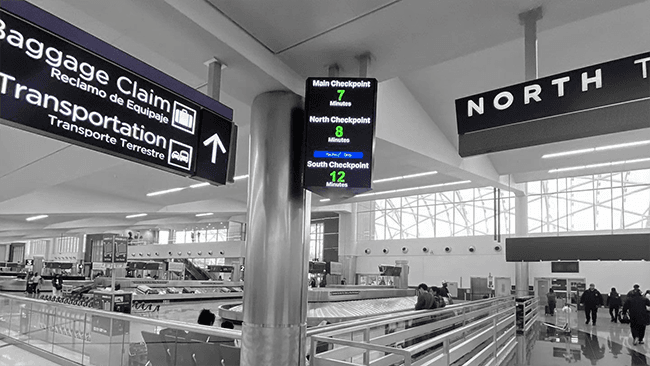
The operational payoff
Fewer questions at the information desk means calmer baggage halls and fewer staff pulled away from other duties to answer the same handful of questions on repeat. That is a direct, measurable operational saving, not just a passenger experience improvement.
It also opens another advertising and sponsorship surface in a part of the terminal that traditionally carried none, since the same platform already powering wayfinding and flight information can carry welcome and local content here too, like at Hartsfield-Jackson Atlanta International and across the wider connected estate. A screen that used to do nothing but list carousel numbers becomes a genuine revenue surface.
Why arrivals deserves the same infrastructure as departures
Airports have historically invested far more in the departures experience than arrivals, on the assumption that arriving passengers simply want to leave. In practice, arriving passengers are navigating an unfamiliar building under time pressure with luggage, exactly the conditions where a connected, self-service environment reduces the most friction.
Building the arrivals experience on the same infrastructure as departures, rather than as an afterthought procured separately, means the investment already made in live data, widgets and templates elsewhere in the terminal extends naturally into the one part of the journey that is otherwise easy to overlook.
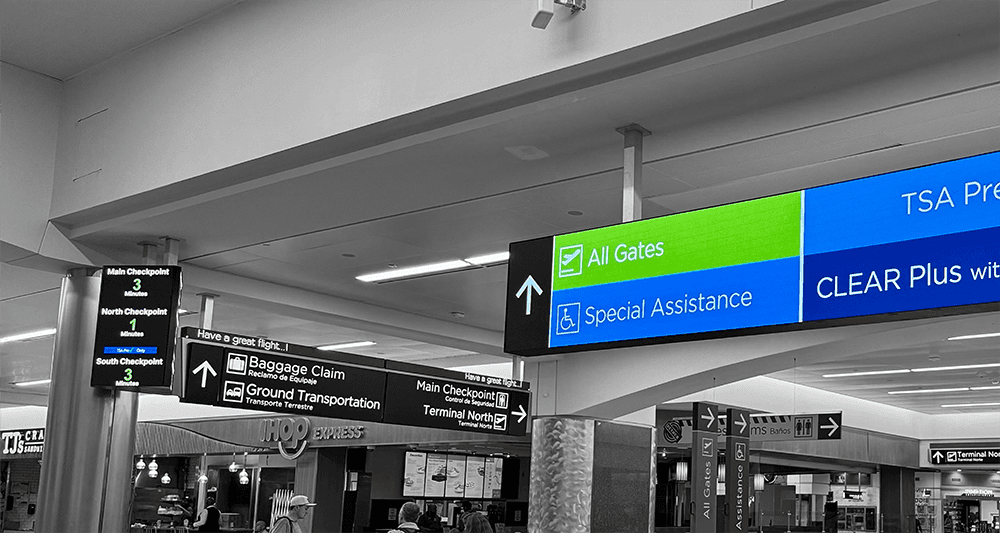
A small use case with an outsized effect on first impressions
Arrivals are disproportionately important to how a passenger remembers an airport, since it is often the first and last extended interaction they have with the building on either end of their trip. A calm, well-informed baggage hall leaves a very different impression from a crowded one where nobody can tell if their bags have arrived yet.
Because a smart baggage information display sits on the same connected infrastructure as the rest of the terminal, improving that first impression does not require a separate project. It requires extending a platform the airport has often already invested in elsewhere into the one zone that is easiest to leave behind. If you'd like to learn more about connected space infrastructure, check out this blog.
Conclusion
Arrivals is not a lesser version of the departures experience. It is a different set of questions, arriving at a moment of higher stress, and a connected infrastructure can answer both from the same platform.
Want to see what a connected arrivals experience looks like end to end? Get in touch to arrange a walkthrough.
what's next
Want to know more?
Book a consultation with our experts
By submitting this form you agree to our terms.