

Directional signage is the quiet infrastructure of an airport, the panels and totems passengers barely notice unless they are wrong. A static sign is only ever as accurate as the last time someone updated it by hand, which is precisely the weak point in a terminal where gates, queues and closures change by the hour, often faster than any manual update process can keep pace with. On a connected infrastructure, directional signage stops being something a team maintains and becomes something the platform generates on its own.
Generated, not maintained
Directional signage built on a connected infrastructure is generated from the same mapping platform that powers indoor wayfinding, rather than maintained as a separate, manually edited system. Walk times and directions compute themselves as conditions change, so nobody has to hand-edit a sign the moment a gate range shifts or a route temporarily closes.
This changes the maintenance model entirely. A traditional signage estate requires a team monitoring for changes and manually pushing updates. A generated signage estate updates itself the moment the underlying map data changes, which removes an entire category of operational overhead while also removing the lag between a change happening and a sign reflecting it.
It also removes a common source of passenger mistrust: the outdated sign still pointing at a gate range that closed months ago, or a route that no longer exists after a terminal redevelopment. Generated signage cannot fall out of date in the way a manually maintained sign inevitably does, because it is never manually set in the first place.
Live data, not last week's estimate
Security and queue wait times stream directly from queue sensors into the same signs, multi-language content runs rotating or side-by-side without a separate translation workflow, and staff can trigger instant overrides for emergency or operational messaging the moment it is needed, not after the next scheduled content update.
The override capability matters especially during disruption. A terminal-wide message, a gate closure, a security incident, a weather delay, can reach every directional sign in the estate simultaneously, rather than being posted to some signs and missed on others because they run on a different system or update schedule.
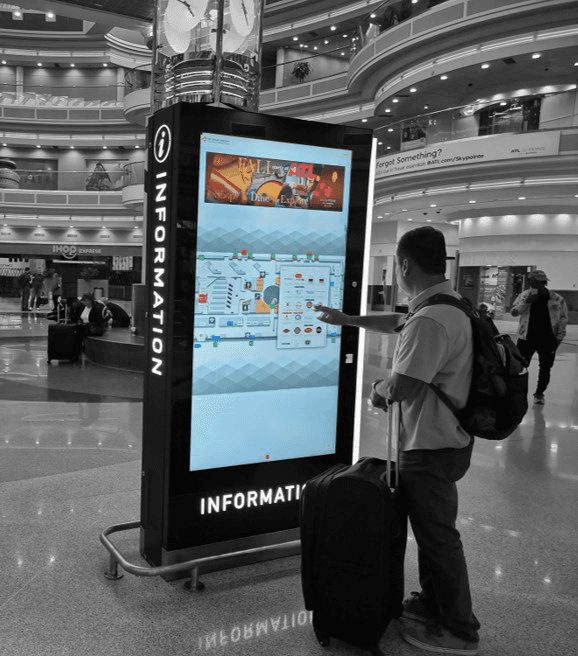
The quiet superpower
Because this signage draws from the same live data as every wayfinding kiosk and flight information display in the terminal, it can never drift out of sync with them. A gate change reaches a directional sign at the same instant it reaches the departures board, which is the entire point of running one connected infrastructure rather than several separate systems that each have to be told the same thing individually.
An easy use case to underestimate
Directional signage rarely gets the attention that a wayfinding kiosk or a large-format installation does, precisely because it is designed to be unremarkable. That makes it an easy use case to underestimate when planning a connected infrastructure rollout, even though it is one of the simplest to generate directly from data an airport is often already collecting through queue sensors and its mapping platform.
For airports auditing their current estate, directional signage is frequently one of the fastest wins available: the underlying data usually already exists, and the manual update process it replaces is one of the more resource-intensive parts of running a large signage estate by hand.
Conclusion
The best directional signage is the kind nobody has to think about, because it updates itself before anyone notices it needed to, and stays in step with every other screen in the building while it does.
Want signage that updates itself from live terminal data? Get in touch to see it running.
what's next
Want to know more?
Book a consultation with our experts
By submitting this form you agree to our terms.