

Not every wayfinding platform is built with the integrator in mind. Plenty are designed for the end user: the facilities manager who logs in once a month, the marketing team updating a map. Fewer are engineered for the people who actually deploy, configure, and support them across dozens of sites, year after year.
For AV integrator solutions to hold up in enterprise wayfinding and interactive signage deployments, across campuses, airports, and other complex environments, the platform has to do more than display a map well. Here are the seven capabilities worth demanding before you commit to a partnership.
1. Deep, open API access
A wayfinding platform's API is the single biggest predictor of how much of your time it will consume. Shallow APIs get you a working map and little else. Deep, well-documented APIs, with native plugins and support for third-party triggers and data feeds, let you connect wayfinding to whatever the client already runs: booking systems, access control, flight data, room scheduling.
This is not a nice-to-have. It is what determines whether a custom client request is a configuration change or a workaround built on duct tape.
2. Genuine multi-building and multi-site scalability
A platform that handles one building well does not automatically handle a campus. Multi-building campus navigation means synchronising floor plans, wayfinding logic, and content across buildings that were often added to an estate at different times, on different systems.
Check whether the platform treats a multi-site deployment as a single connected environment or as several separate installs sharing a login screen. The difference matters at rollout, and it matters again in two years when the client adds a new building and expects the system to extend, not be rebuilt.
3. Bespoke customisation beyond the template library
Customisable digital signage means different things to different vendors. For some, it means a colour picker and a handful of layout templates. For integrators working on enterprise or campus deployments, it needs to mean genuinely bespoke builds: custom kiosk hardware, branded interfaces, and interfaces designed around how a specific environment actually works.
Ask to see an example of a fully bespoke deployment, not the standard demo. If the vendor cannot show one, the platform's customisation likely stops at cosmetic.
4. Mission-critical reliability and failover
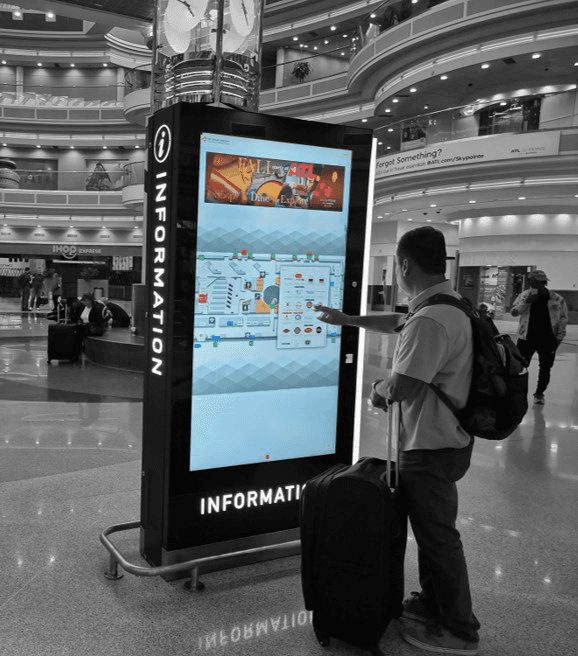
Airport wayfinding systems and other high-footfall environments have no acceptable downtime. A screen going dark in a live terminal, or a hospital directory freezing mid-shift, is a failure with real consequences, not an inconvenience.
Look for a fail-safe backup player that maintains uptime without manual intervention, and ask specifically how failover works, not just whether it exists. Reliability at this level is engineered in from the start. It is not something bolted on after a platform proves itself in lower-stakes environments.
5. Remote support tools built for integrators, not just end users
There is a real difference between a dashboard designed for a marketing team to update content, and support tooling designed for the people troubleshooting a network of sites remotely. Integrators need real-time alerts, remote reboot and recovery, and visibility into device health across an entire estate, without needing a technician on-site for routine issues.
If the only support option is a ticket to the vendor, the support burden sits with you regardless of what the platform claims about reliability.
6. Hardware-agnostic deployment
Platforms that lock integrators into proprietary hardware limit flexibility and add cost to every deployment, particularly across mixed estates where clients already have equipment they expect to keep using. Enterprise wayfinding software should work across the hardware you already spec, install, and support, not force a hardware refresh as a condition of the software.
This becomes especially relevant on multi-building campus navigation projects, where existing kiosks, screens, and displays are rarely uniform across an estate built up over several years.

7. A commercial model that rewards the relationship, not just the sale
The best wayfinding platform is worth little to an integrator if the commercial structure treats you as a one-off reseller rather than a long-term partner. Look for a model built around recurring revenue tied to support and expansion, not a single licence fee with nothing built in for what comes after go-live.
Platforms designed around a genuine partner ecosystem tend to reflect this from the start, with special partner pricing and support tools that make managing a growing network of sites sustainable rather than a drain on margin.
The platform, not the pitch
Any vendor can demo a map. Fewer can show you an API deep enough for a genuinely custom build, a support structure that reduces your workload instead of adding to it, and a commercial model that makes long-term partnership worthwhile. Before signing with a wayfinding platform, ask for evidence against all seven, not just the ones that show well in a fifteen-minute demo.
what's next
Want to know more?
Book a consultation with our experts
By submitting this form you agree to our terms.