
Every year, a handful of new entrants arrive in the airport signage market with polished demos, striking visuals and a pitch built almost entirely around what the screen looks like. Airports are drawn in, because the demos genuinely are impressive. But a terminal is not a demo. It is a mission-critical environment running twenty-four hours a day, and the screen itself is the smallest part of what actually has to work. Behind every departure board, wayfinding kiosk and gate display sits a layer nobody sees: scheduling, content management and playout, built to survive the moment a gate changes, a flight diverts, or a network drops. That is the part newcomers skip. It is also the part that decides whether your terminal keeps running or goes dark.
The demo trap
Plenty of newer entrants to airport signage are creative agencies first. Their strength is the pitch: beautiful mock-ups, slick motion graphics, a screen that looks unlike anything else in the terminal. For a boardroom presentation, that is compelling. For a live airport, it is not the same problem at all.
An airport terminal is not a single screen running a loop. It is hundreds of screens, pulling from flight data feeds, queue sensors and mapping systems, all needing to agree with each other in real time, all day, every day, for years. Scheduling, management and playout are not an afterthought to that problem. They are the problem. Get the visual layer right and skip the infrastructure underneath it, and what you have built is a demo that cannot survive contact with a live terminal.
What signage-grade actually means
For an airport, signage-grade means something specific: enterprise scheduling and playout built over decades, not months. It means a security posture designed for critical infrastructure, with on-premise options where operators need them, monitored players rather than a fire-and-forget install, and long-term support that does not disappear once the contract is signed.
Acquire Digital's platform carries over 28 years of scheduling, content management and playout experience behind it, running today across more than 25,000 installations. That is not a marketing statistic. It is the difference between a screen that plays content and a connected space infrastructure that an airport can physically run its operations on.
Reliability is a design decision, not an accident
Screens going dark at an airport is not a minor inconvenience. It is a passenger standing in a concourse with no idea where their gate is, or a departures board frozen on yesterday's flights during a disruption. Reliability at that level does not happen by chance. It has to be engineered in: automatic failover when a player drops, live monitoring across every screen in the estate, and a system that recovers itself before anyone downstream notices there was a problem at all.
That is the standard an airport should hold any signage-grade partner to, and it is worth asking directly in any pitch: what happens to this screen when something goes wrong, and who is watching when it does?
One in-house team, no agency handoffs
The other quiet cost of the demo-first approach is what happens after the sale. Creative agencies often outsource the underlying platform, which means an airport ends up managing two relationships instead of one: the agency for design, and a separate vendor for the infrastructure running underneath it. When something breaks, the finger-pointing starts.
An in-house design department that builds and maintains templates directly on the same platform that runs playout removes that seam entirely. One team, with one point of accountability, means no handoffs.
Proven where it matters most
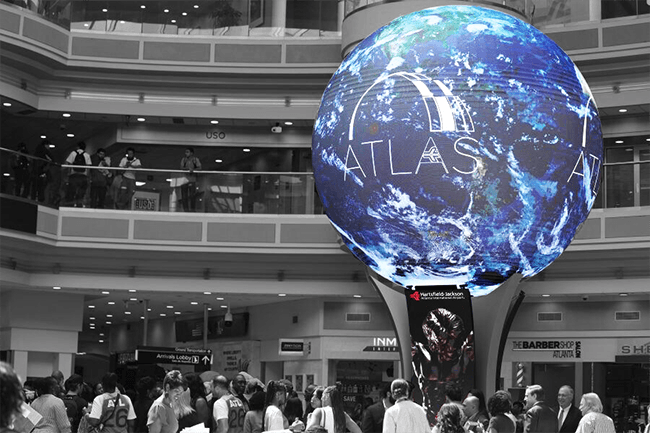
This is not a theoretical distinction. Acquire Digital's connected space infrastructure is live today at Hartsfield-Jackson Atlanta International, the world's busiest airport, powering everything from Wayfinder kiosks to Atlas, a 360-degree LED sphere running as a signature concourse experience.
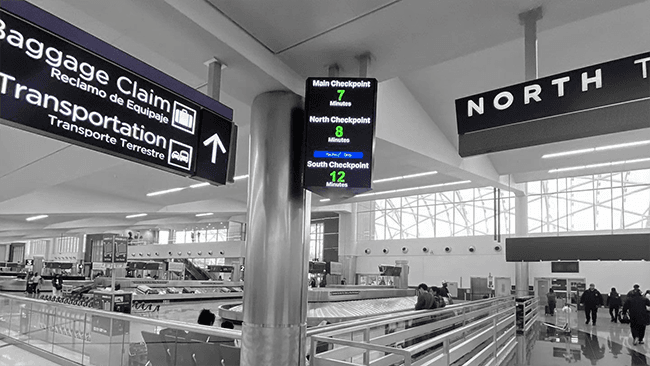
At Philadelphia International Airport, the same infrastructure unified three previously separate systems, Atrius mapping, Amadeus flight data and Clear Channel advertising, into a single Wayfinder-led passenger experience, complete with boarding-pass gate routing, live flight data, advertising, remote assistance and mobile handoff . Neither environment was built on a demo. Both are built on infrastructure engineered for environments where failure is not an option.
The real question to ask
The next time an airport signage pitch leads with the screen, it is worth asking what sits underneath it: how long has this scheduling and playout engine been in production, what happens when a player fails at 6am on a Monday, and who is accountable when it does. Those answers separate a connected space infrastructure from a very good demo.
Curious what that looks like running live at scale? Get in touch to see Acquire Digital's connected space infrastructure in action at Hartsfield-Jackson Atlanta and Philadelphia International.
what's next
Want to know more?
Book a consultation with our experts
By submitting this form you agree to our terms.