

The Insight
No airport sets out to fragment its own operations. It happens one reasonable decision at a time: a wayfinding vendor here, a separate flight information system there, a different partner again for advertising revenue. Each choice looks sound in isolation, evaluated on its own merits against its own shortlist.
Add those decisions up across a terminal, though, and most airports end up running the same way: several vendors, several contracts, several data feeds that were never designed to agree with each other. Nobody notices the cost of that arrangement on a quiet Tuesday afternoon. It reveals itself the moment the environment is under pressure, a gate change, a security delay, a diversion, when the departures board, the wayfinding kiosk and the gate screen each tell the passenger something slightly different.
Where the cost actually lands
Fragmentation carries a cost in four places, and airports typically only ever budget for the first.
Operational cost
Every additional vendor is another data feed to reconcile, another support line to call, another system that needs its own troubleshooting when something goes wrong. Operations teams end up spending time proving whose system is out of date, rather than acting on the answer.
Passenger cost
When screens disagree, passengers do not conclude that one system is slightly out of sync. They conclude the airport does not know what is happening, and they ask a member of staff to confirm it. Multiply that by every screen a passenger passes on a journey through a multi-terminal environment, and a small data mismatch becomes a measurable increase in staff interruptions.
Commercial cost
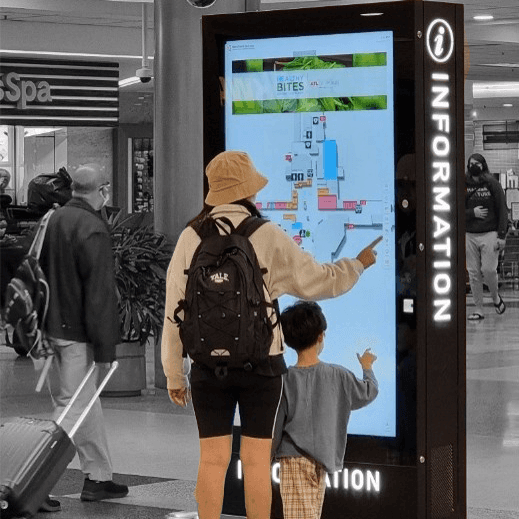
Wayfinding kiosks, departure boards and gate screens are all advertising and sponsorship inventory. Point solutions that cannot share data with each other cannot easily share that inventory either, which means missed programmatic and direct advertising revenue that a unified infrastructure would otherwise capture.
Risk cost
With several vendors in place, an airport rarely has one accountable party when something fails at the moment it matters most. Accountability gets divided precisely when it needs to be immediate.
Unite, don’t necessarily replace
The airports furthest ahead on this are not necessarily replacing every system they own. They are unifying what they already have around one connected space infrastructure, and building new capability on top of it.
Philadelphia International Airport
Philadelphia had already invested in Atrius for mapping, Amadeus for flight data, and Clear Channel for advertising, three systems, three vendors, none of them talking to each other. Rather than replace all three, the airport unified them around Wayfinder as the central hub. The result is a single passenger experience spanning boarding-pass-triggered gate routing, live flight data, advertising, remote assistance and mobile handoff, all drawing on the same live data.
The lesson generalises well beyond Philadelphia: the most effective connected environments do not necessarily replace existing infrastructure. They unite it.
Read more about our work with Philadelphia International Airport.
Hartsfield-Jackson Atlanta International
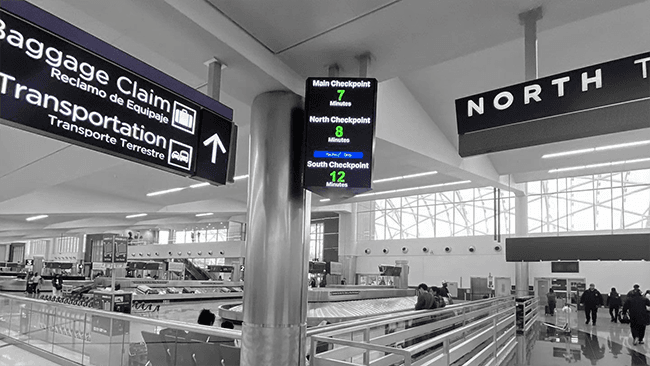
At the world's busiest airport, a single connected space infrastructure now powers everything from Wayfinder kiosks to Atlas, a 360-degree LED sphere serving as a signature concourse experience, alongside directional signage and gate displays, all reading from the same live data source. Nothing on that estate disagrees with anything else on it, because nothing on it is running on a separate system.
Read more about our work with Hartsfield-Jackson Atlanta International.
The question worth asking before the next procurement
For an airport assessing its own estate, the useful question is rarely "do we have a wayfinding system" or "do we have a flight information display". Most airports already have several. The more useful question is: Is what we have actually connected, or are we running several point solutions that happen to sit in the same terminal?
A practical starting point:
Map every screen and system currently in the terminal against the data feed it draws from, and note where two systems draw from the same source but present it differently.
Ask any prospective partner what happens to a screen when its player fails, and who is accountable for fixing it, before asking what the screen looks like.
Prioritise infrastructure that can unify what is already installed over infrastructure that requires a full rip-and-replace, since most airports cannot take screens offline to make the switch.
Choose a platform with an open API and a template model, so a new use case, another advertising surface, a new wayfinding touchpoint, is a configuration exercise rather than a new procurement.
Fragmentation is rarely a single bad decision
It is the accumulation of several reasonable ones, made without a shared infrastructure to hold them together. Unifying what already exists is usually a smaller project than it looks, and the alternative, discovering the cost of fragmentation during a live disruption, is a far more expensive way to find out.
Curious what a unified connected space infrastructure looks like running live at scale? Get in touch to see how Acquire Digital brought Philadelphia International's mapping, flight data and advertising together on one platform.
what's next
Want to know more?
Book a consultation with our experts
By submitting this form you agree to our terms.