

For AV integrators, choosing a wayfinding platform is not a one-off decision. It is a bet on what you will be supporting, configuring, and troubleshooting for the next several years, across every campus, airport, or enterprise site you deploy it on. Get it right and the platform becomes a business you build on. Get it wrong and it becomes a support queue.
Most comparison guides focus on what the software can display: 3D maps, turn-by-turn directions, multi-language support. Those are baseline expectations in 2026, not differentiators. The decision that actually matters for integrators is what happens after go-live, across dozens of sites, over years of change requests.
Here is what to evaluate when choosing digital wayfinding and interactive signage platforms, from an integrator's perspective rather than an end-user's.
Customisable digital signage: configurable, or actually flexible?
Every vendor calls their platform customisable. Few mean the same thing by it. For an integrator, the real test is whether customisation happens through templates and colour schemes, or whether it extends to genuine bespoke deployment: custom kiosk hardware, branded interfaces, and integrations with a client's own systems.
A platform built around a fixed template library will get you through a straightforward single-site deployment. It will not hold up when a campus client wants wayfinding tied into their room booking system, or an enterprise client wants their existing access control data feeding into the same interface. Ask what a genuinely bespoke build actually involves, not what the out-of-box demo shows.
API and integration depth: the question that determines your margin
This is where most platforms reveal their limits. A wayfinding tool with a shallow API will get you a working map. A platform with genuine integration depth, native plugins, open APIs, and support for third-party triggers and data feeds, lets you build something a client cannot get anywhere else.
Integration depth is also what protects your margin. Shallow platforms mean every non-standard request becomes a workaround, eating time you cannot bill for. Platforms built with modular, plugin-based architecture are designed for that kind of custom integration from the ground up, which means the work you already know how to price stays predictable as client requirements grow.

Multi-building campus navigation: complexity that compounds
Single-building wayfinding is a solved problem for most platforms on the market. Multi-building campus navigation is where the differences show. A university, hospital trust, or corporate campus deployment means synchronising navigation data across buildings that may have been added to the estate at different times, on different systems, with inconsistent floor plans.
The platform needs to treat the campus as one connected environment, not a set of individually mapped buildings that happen to share a login. For integrators, this matters at rollout and it matters two years later, when the client adds a new building and expects the wayfinding to extend without a rebuild.
Airport wayfinding systems: reliability with no room for downtime
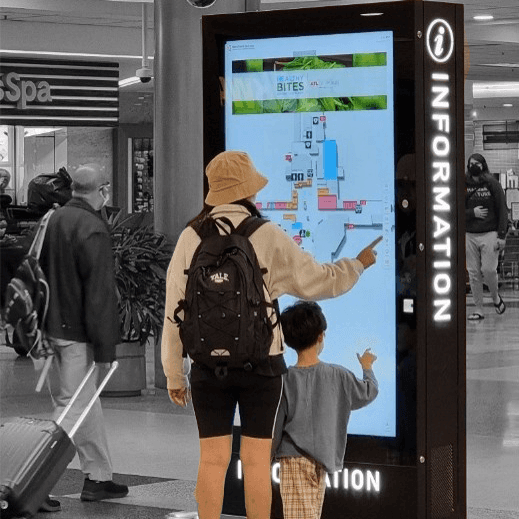
Airport wayfinding systems sit at the far end of the reliability spectrum. There is no acceptable failure mode for a directional screen or interactive kiosk in a live terminal. For integrators working in this space, the evaluation criteria shift from "does it work" to "what happens when something goes wrong."
Look for fail-safe backup players that maintain uptime without manual intervention, remote monitoring that flags an issue before a passenger does, and a support structure that does not require a technician on-site for routine recovery. Airport environments also tend to demand deep integration with flight data, wayfinding tied to boarding passes and gate changes, which is a meaningful test of how far a platform's API actually extends beyond the demo.
What to weigh beyond the demo
A product demo shows you the interface. It does not show you the support burden six months into a live deployment, or whether the vendor's roadmap includes the features your next client will ask for. Before committing to a wayfinding platform, integrators should be asking about three things a demo will not answer:
Support tools
Can you manage and troubleshoot a network of sites remotely, or does every issue need a site visit? Platforms built with integrators in mind provide dedicated support and monitoring tools designed to reduce that overhead, not just end-user dashboards repurposed for technical support.
Recurring revenue structure
Does the commercial model reward you for ongoing support and expansion, or is it a single licence sale with nothing built in for the relationship afterwards? A platform designed around a partner ecosystem, rather than direct-to-end-user sales, tends to be structured with integrator margin in mind from the start.
Vendor lock-in
Does the platform require proprietary hardware, or does it work across the hardware you already spec and support? Hardware dependency limits flexibility and adds cost to every deployment, particularly across mixed estates where clients have existing equipment they want to keep using.
The real evaluation criterion
The wayfinding platforms worth building a business on in 2026 are not the ones with the longest feature list. They are the ones engineered as genuine infrastructure: deep enough to integrate with anything a campus, airport, or enterprise client throws at them, reliable enough for environments where downtime is not an option, and structured commercially so that supporting them is worth your time.
Before signing a partner agreement, ask what a bespoke, multi-building, mission-critical deployment actually looks like on that platform, not what the standard demo covers. The answer will tell you whether you are choosing a tool or a business partner.
what's next
Want to know more?
Book a consultation with our experts
By submitting this form you agree to our terms.